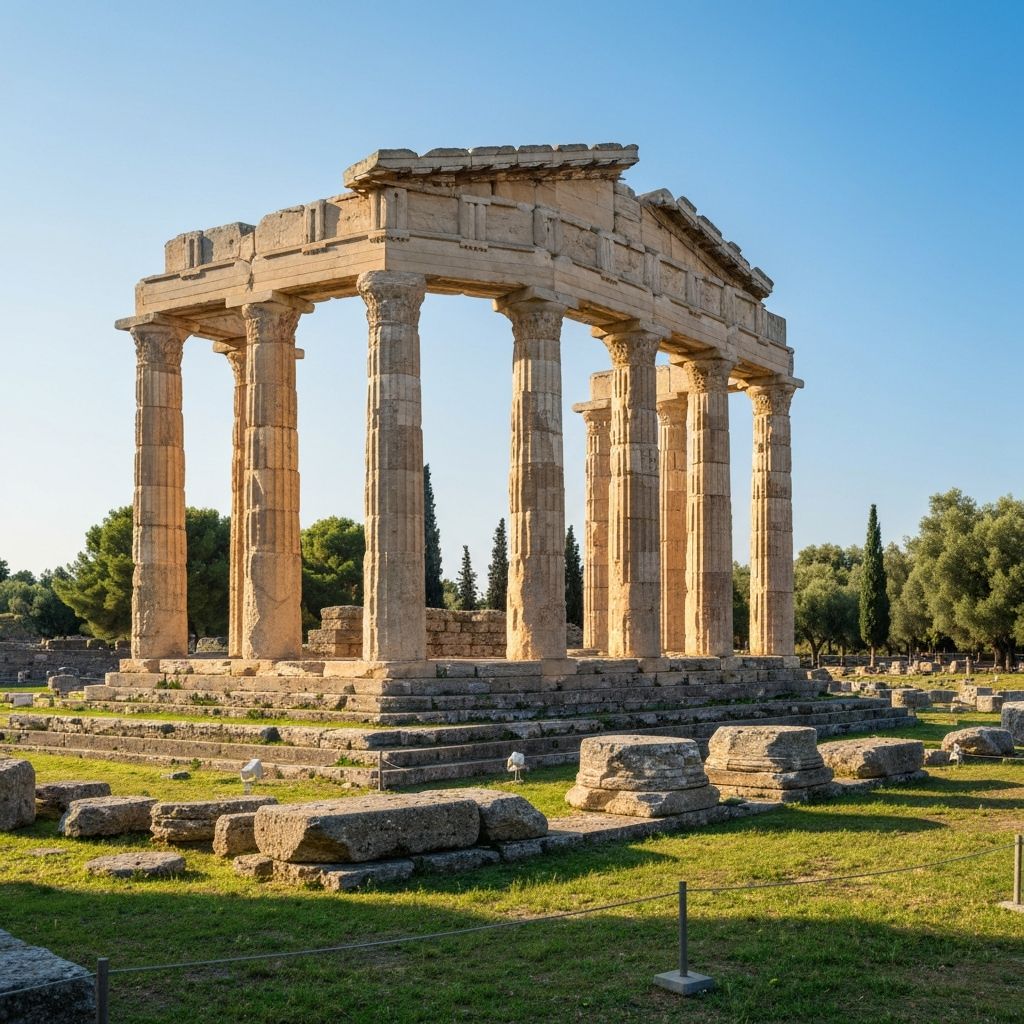
The Ancient Greek Olympics: Why Olympia Was So Important
Discover the origins, significance, and legacy of the greatest sporting event in ancient history
The Origins of the Ancient Olympic Games
The Ancient Olympic Games began in 776 BC in Olympia, Greece - not on Mount Olympus as commonly confused. According to tradition, the games were founded by Heracles (Hercules) in honor of his father Zeus, king of the gods.
Religious and Cultural Significance
The Olympics were first and foremost a religious festival. Athletes competed not just for glory but as offerings to Zeus. The games took place in a sacred grove called the Altis, where temples, altars, and treasuries created a powerful spiritual atmosphere.
Early Games and Traditions
The first Olympics featured only one event: the stadion, a 192-meter foot race. Over centuries, the games expanded to include wrestling, boxing, chariot racing, and the pentathlon. Athletes competed nude, and only free Greek men could participate.
Olympic Timeline
Traditional date of the first Olympic Games
Games expanded beyond foot races
Games reorganized, lasting five days
Romans conquer Greece, games continue
Emperor Theodosius I bans the games
Temple of Zeus destroyed
Olympia: The Sacred Site of the Games
The sanctuary at Olympia was one of the most important religious sites in ancient Greece
Housing one of the Seven Wonders - the statue of Zeus
The altar where the Olympic flame was lit
The original stadium seating 45,000 spectators
Gymnasiums and palaestra for athletes
Olympia is located in the western Peloponnese, at the confluence of the Alpheus and Kladeos rivers. This fertile valley in Elis was considered neutral ground - not belonging to any single city-state - making it ideal for pan-Hellenic gatherings.
The site's remoteness from major cities also meant athletes and spectators had to make a significant journey, emphasizing the games' importance and the commitment required to participate.
Why Held Every Four Years?
The four-year cycle, called an "Olympiad," became so significant that Greeks used it to date events throughout history. Instead of a continuous year count, they would say "in the third year of the 75th Olympiad."
Several theories explain the four-year interval:
- Astronomical: The cycle may have been linked to the eight-year cycle of Venus, with games held at the half-way point.
- Practical: Four years allowed adequate time for athletes to train and for news of the games to spread across the Greek world.
- Religious: The cycle aligned with other major religious festivals, creating a rotation of pan-Hellenic events.
The Importance of the Olympics in Ancient Greece
Before each Olympics, heralds proclaimed the "ekecheiria" or sacred truce. All wars between Greek states were suspended, allowing safe passage for athletes and spectators.
This remarkable tradition demonstrated that shared culture and religion could overcome political divisions - a powerful symbol of Greek unity despite constant conflicts.
Olympic victors received only an olive wreath at the games, but their home cities showered them with rewards: free meals for life, front-row seats at events, and sometimes substantial cash prizes.
Poets composed odes to champions, sculptors created statues in their honor, and their names were recorded for posterity. Victory at Olympia was the highest athletic achievement imaginable.
What Happened to the City of Olympia?
After nearly 12 centuries of continuous celebration, the Olympic Games were banned in 393 AD by the Christian Roman Emperor Theodosius I, who viewed them as pagan rituals. His successor, Theodosius II, ordered the temples destroyed in 426 AD.
Earthquakes in 522 and 551 AD further devastated the site. Over centuries, floods buried the ruins under sediment, and Olympia was forgotten until its rediscovery in 1766.
Today, Olympia is a UNESCO World Heritage Site and major tourist destination. The archaeological museum houses some of the finest ancient Greek sculptures, including the famous Hermes of Praxiteles. The site still hosts the Olympic flame lighting ceremony for modern games.
Frequently Asked Questions
Interested in Ancient History?
Explore more ancient sites including Olympos in Turkey - a Lycian city with its own fascinating connection to the name "Olympus."